Baltic Amber Rings UK Buying Guide: Real Stones, Sterling Silver, Honest Pricing
A Baltic amber ring is one of those pieces that sits between heirloom and everyday. The stone is forty four million years old, hand set into sterling silver by jewellers in Lithuania and Poland, and worn by women across the UK as a daily ring that quietly catches every other piece in the jewellery box. This guide walks through what to look for before you buy a Baltic amber ring, the colour and price differences worth understanding, and how to spot the fakes that have crept into the UK market over the last few years.
Key takeaways
- Genuine Baltic amber is fossilised tree resin from the Baltic coast, dated 40 to 44 million years old, with a Mohs hardness of 2 to 2.5.
- Real amber feels warm to the touch, floats in salt water, and glows under UV light. Fakes fail at least one of these tests.
- Sterling silver settings carry the 925 hallmark from a UK assay office. Anything labelled "silver plated" is not solid silver.
- Honey and cognac amber rings start around £30. Cherry, butterscotch and green amber rings typically run £45 to £120.
- Avoid pressed amber and copal sold as Baltic amber. Both are real organic materials, just not what you are paying for.
What makes Baltic amber the standard?
Amber comes from many places around the world. Dominican amber, Burmese amber, Mexican amber and Lebanese amber all exist as legitimate gemstones. So what is special about the Baltic version?
Age and chemistry. Baltic amber dates to the Eocene epoch, roughly 44 million years ago, when forests of an extinct conifer called Pinites succinifer lined the coast of what is now the Baltic Sea. The resin that flowed from those trees buried itself in seabed sediment and slowly polymerised into the hard, translucent stone we know today.
Baltic amber contains 3% to 8% succinic acid, which makes it chemically distinct from other amber varieties. It also accounts for the slight pine scent older Baltic amber gives off when warmed by skin contact. The Gemological Institute of America's amber reference confirms the succinic acid signature as the gemological test that separates Baltic from other ambers.
For UK buyers, the practical implication is that "Baltic amber" should mean amber sourced from Lithuania, Poland, Russia (Kaliningrad), or northern Germany. If a ring is sold as Baltic amber without a country of origin, ask.
How do you tell a real Baltic amber ring from a fake?
There are five tests, and the genuine article passes all five. We see fakes regularly enough that this section is worth taking seriously.
The warmth test. Real amber warms to body temperature within a few seconds of skin contact, and feels warmer to the touch than glass or plastic. This is a function of amber's low thermal conductivity. Glass beads sold as amber fail the warmth test immediately.
The salt water float test. Mix two tablespoons of salt into a cup of warm tap water and stir until dissolved. Drop the amber bead into the saline solution. Real Baltic amber floats. Plastic and glass sink. This test is non destructive and easy to run at home.
The smell test. Touch a hot needle to an inconspicuous part of the amber (the side of a bead, not the polished face). Real amber releases a faint pine forest scent. Pressed amber smells similar but weaker. Plastic and copal smell sharp and chemical.
The UV test. Under ultraviolet light, real Baltic amber fluoresces a soft blue or green. Pressed amber fluoresces but in patches and lines where the heat fused fragments together. Plastic does not fluoresce at all.
The hardness test. Drag a fingernail across an inconspicuous part of the stone. Real amber should resist scratching from a fingernail (Mohs 2 to 2.5) but be scratchable by a copper coin (Mohs 3 to 3.5). Plastic scratches with a fingernail; glass resists a coin.
A real Baltic amber ring will pass all five. If you cannot test before buying, buy from a UK seller who guarantees authenticity with a certificate of origin and a return window long enough for you to do the tests at home.
What about copal and pressed amber?
Two materials cause confusion in the UK market because they are real organic substances, just not what you are paying for.
Copal is younger tree resin, typically 10,000 to 1 million years old. It looks similar to amber, smells similar when warmed, but has not polymerised into a true gemstone. Copal is softer (Mohs 1.5 to 2), cracks faster, and dissolves in alcohol. It is sold legitimately as copal at lower prices, but occasionally misrepresented as Baltic amber.
Pressed amber is real Baltic amber but processed. Small fragments and powder are heated and compressed into a single piece. Pressed amber is genuine in composition but lacks the rarity premium of natural pieces. Many high street rings under £15 are pressed amber. The honest brands label it as such; less honest sellers do not.
Neither material is fraudulent in itself. The fraud is in the labelling. If you want a natural Baltic amber ring, look for the phrase "natural amber" or "untreated Baltic amber" on the product description, not just "amber".
Our Baltic amber rings collection only stocks natural untreated stones, and every ring ships with a certificate of authenticity stating the country of origin and the amber variety.
What colours of Baltic amber rings are available?
The seven recognised colour grades of Baltic amber appear in rings to varying degrees. Common pricing for a single stone ring in 925 sterling silver, May 2026:
| Colour | Appearance | Rarity | Typical UK price for silver ring |
|---|---|---|---|
| Honey | Translucent gold | Common | £30 to £55 |
| Cognac | Deep amber brown | Common | £35 to £60 |
| Lemon | Pale yellow | Common | £35 to £55 |
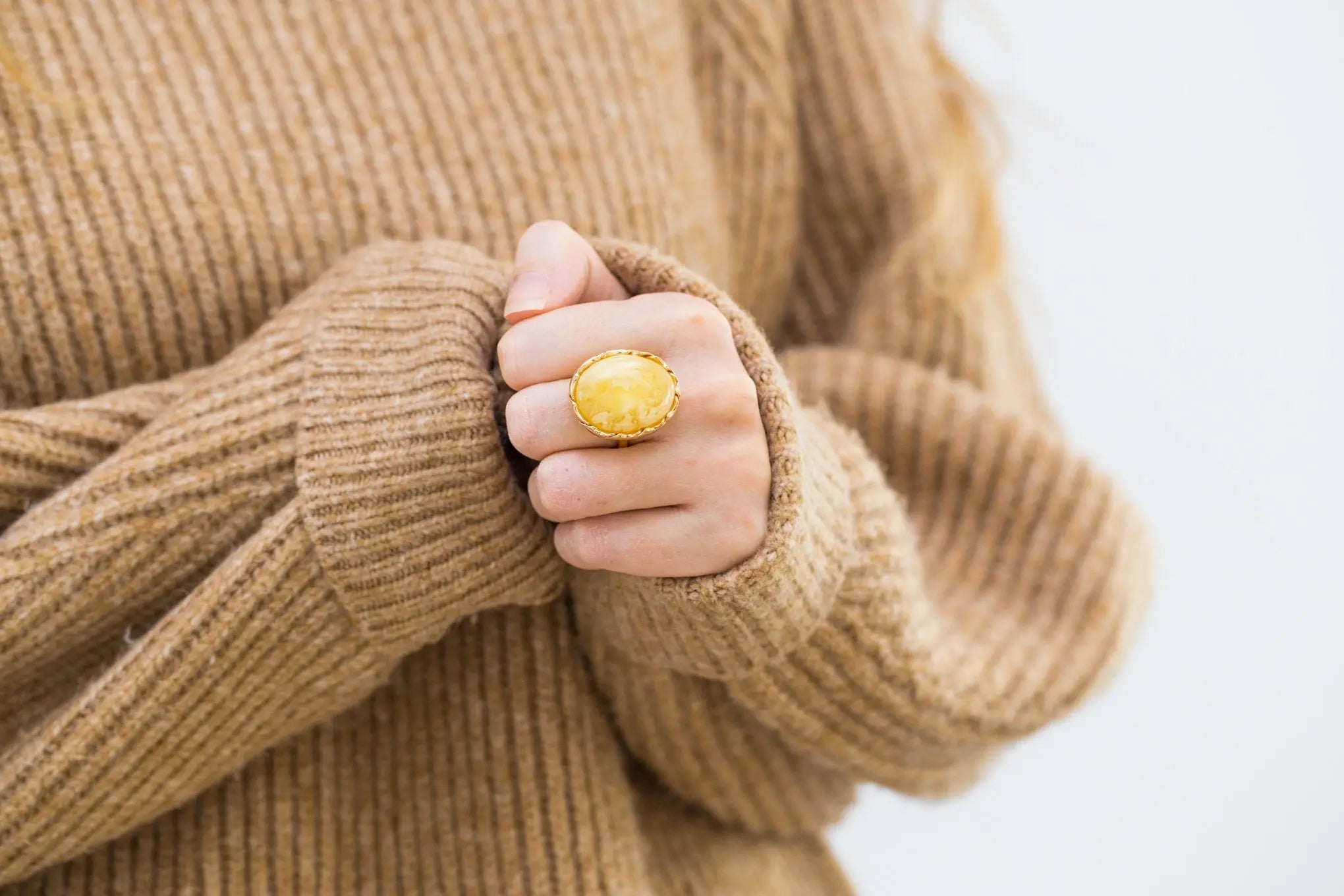
| Butterscotch | Opaque cream gold | Less common | £45 to £85 |
| Cherry | Deep red brown | Uncommon | £55 to £110 |
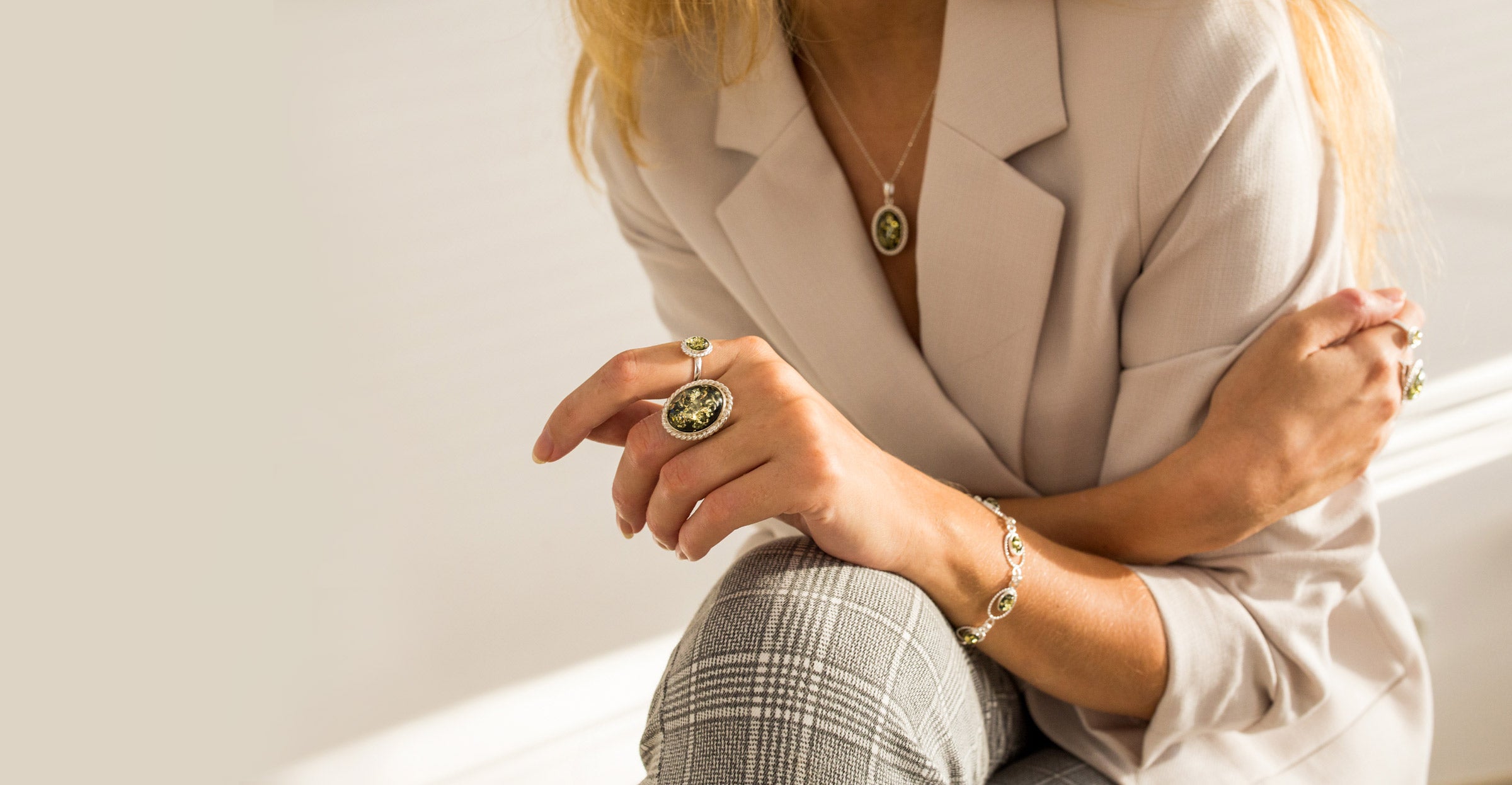
| Green | Olive to emerald | Rare | £70 to £150 |
| White | Milky off white | Rare | £80 to £160 |
The colour you choose is mostly aesthetic, with one practical consideration. Darker colours (cherry, cognac) show daily wear less than lighter colours (honey, lemon). White and butterscotch amber show fingerprints and skin oils faster and need more frequent cleaning.
Our about Baltic amber page covers the geological origins of each colour, including why green amber is naturally rare (plant matter inclusions during fossilisation) and why white amber appears opaque (microscopic gas bubbles).
What setting should I choose for a Baltic amber ring?
925 sterling silver is the standard. Two reasons.
First, the warmth of amber pairs naturally with the cool tone of silver, and the contrast highlights the stone's translucency. Yellow gold tends to flatten the visual difference between metal and stone.
Second, sterling silver is hypoallergenic for most wearers, and the 925 hallmark from a UK assay office is a clear quality signal. The London Assay Office and the assay offices in Birmingham, Sheffield and Edinburgh all hallmark silver above 7.78 grams.
Three setting styles dominate the Baltic amber ring market:
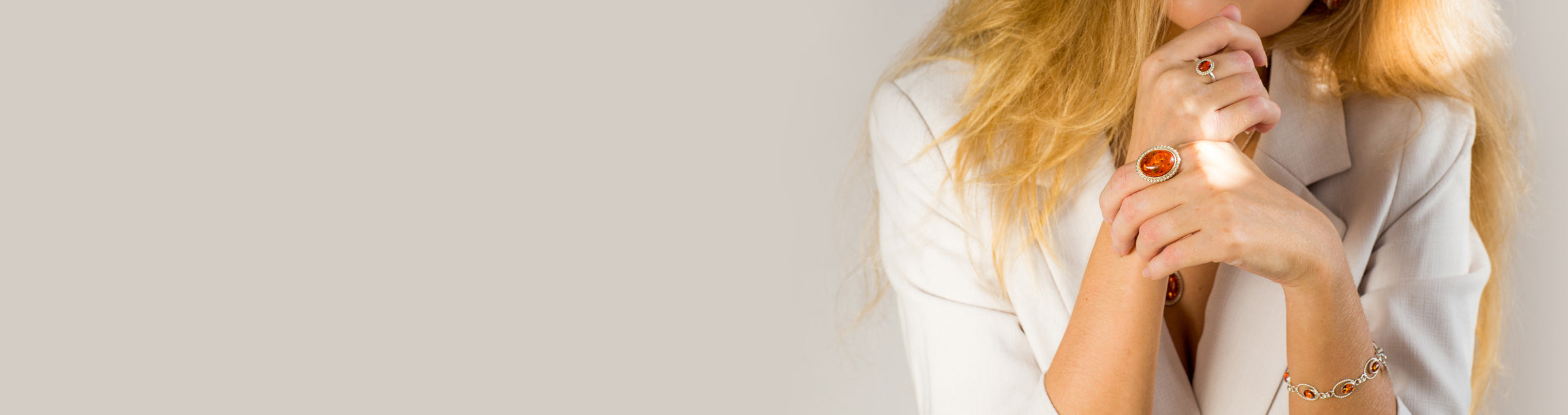
Bezel setting. The amber sits in a thin silver rim that wraps the stone. Most secure for daily wear; protects the stone from knocks.
Open back setting. Light passes through the back of the amber, intensifying the colour. Beautiful for cocktail rings; less durable for everyday wear.
Cabochon setting. A domed amber stone sits flush in a wider silver base. Modern, low profile, comfortable under gloves.
Avoid prong settings on amber. The Mohs 2 to 2.5 hardness means prongs can dent or crack the stone over time.
How much should I expect to pay for a real Baltic amber ring in the UK?
A natural Baltic amber ring in 925 sterling silver, sized 50 to 60, with a single small to medium stone, runs £30 to £80 in 2026 for honey, cognac and lemon amber. The rarer colours climb from there into the £60 to £160 range.
Three things drive the price within that band:
- Size of the stone. A 10 mm cabochon costs roughly twice what a 5 mm stone does.
- Colour rarity. Green and white amber stones command a 50% to 80% premium over honey.
- Silver weight. Thick band settings use more silver than delicate ones.
Anything sold as a Baltic amber ring under £20 is almost certainly pressed amber, copal, or plastic. Genuine sale prices in our amber jewellery range sit at £25 and above even at deepest discount.
Can I wear a Baltic amber ring every day?
Yes, with two adjustments to your habits.
First, take it off before sleep. Bedding fibres scuff amber over thousands of nights and the cumulative dulling shows after a year. A pouch by the bedside fixes this.
Second, take it off before bath, shower, swimming pool, and exercise. Water plus shampoo plus chlorine plus sweat is the main reason amber rings dull within a few months of purchase. Wearing the ring only when dry triples its lifespan.
If you remember those two rules, a Baltic amber ring will hold its colour and shine for decades.
Frequently asked questions
Is Baltic amber a real gemstone? Yes. Amber is classified as an organic gem alongside pearl and coral.
Can Baltic amber rings be resized? The silver band can usually be resized by a UK jeweller. The amber stone itself is not resizable.
Is it safe to wear Baltic amber if I have sensitive skin? Yes. Amber itself is hypoallergenic and the 925 sterling silver setting rarely triggers reactions.
How long does a Baltic amber ring last? With normal care, a lifetime. Many UK customers wear amber rings inherited from grandmothers that are sixty plus years old.
Why does some Baltic amber look cloudy and some look clear? The cloudy appearance is caused by microscopic gas bubbles trapped during fossilisation.
Can I buy a Baltic amber engagement ring? Yes. The practical caveat is that amber is softer than traditional engagement diamonds and will show wear faster.