How to Clean Baltic Amber Jewellery Without Ruining It
Baltic amber is older than most people realise. The piece around your neck spent forty four million years underground before someone polished it into a pendant. That kind of stone deserves a cleaning routine that respects its quirks, because amber is not a hard gemstone, it cannot handle the products that work on diamond or sapphire, and the wrong cloth can leave permanent scuffs. This guide walks through what to do, what to avoid, and what to never put on Baltic amber.
Key takeaways
- Clean Baltic amber with a soft damp cloth and lukewarm water. Nothing more aggressive than that.
- Never use ultrasonic cleaners, steam cleaners, jewellery dips, or any solvent containing alcohol or ammonia.
- Silver tarnish on the setting needs different treatment to the amber itself. Polish separately.
- Store amber in a soft pouch away from direct sunlight to prevent the stone darkening or cracking over time.
- Rare green amber and white amber need an even gentler touch than the more common honey and cognac varieties.
Why does Baltic amber need such gentle cleaning?
Baltic amber is fossilised tree resin, not a mineral. On the Mohs hardness scale it scores between 2 and 2.5, which puts it softer than your fingernail. The Gemological Institute of America classifies amber as an organic gem, in the same category as pearl and coral, meaning it reacts to chemicals the way wood or skin would, not the way a hard crystal would.
Three implications follow directly from this:
- Solvents dissolve it. Alcohol, acetone and ammonia all break down amber on contact. So do the propellants in some hairsprays and the fragrance carriers in some perfumes.
- Heat warps it. Steam cleaners and hot water above 40 degrees soften the surface enough to dull the polish permanently.
- Abrasives scratch it. Anything more aggressive than a soft microfibre cloth leaves marks. Toothbrushes are too rough. Salt and bicarbonate are far too rough.
Knowing this, the actual cleaning routine becomes simple by elimination.
The everyday cleaning routine for Baltic amber
This is the routine that works for honey amber, cognac amber, butterscotch amber, cherry amber and the rare green and white varieties. Five minutes, no equipment beyond what is already in your kitchen.
Step one. Fill a small bowl with lukewarm tap water. Test the temperature on your wrist. If it feels warm rather than hot, it is right.
Step two. Dip a soft microfibre cloth into the water and wring it almost dry. The cloth should be damp but not dripping.
Step three. Wipe the amber gently. Use small circular motions, with no pressure. The aim is to lift skin oils and dust from the surface, not to scrub.
Step four. Dry immediately with a separate dry microfibre cloth. Leaving amber to air dry on a hard surface can leave water spots and risks knocks if anything else lands on it.
Step five. Buff lightly with a clean dry cloth to restore the natural shine. Do not use chamois leather, which is too oily and can leave a hazy film.
That is the entire routine. Done weekly for jewellery you wear daily, or once after each wear for occasional pieces, it keeps amber bright for decades.
How to clean the silver setting around the amber
Most Baltic amber jewellery is set in 925 sterling silver, which tarnishes naturally over time. The tarnish is harmless but unflattering. The trick is cleaning the silver without letting the cleaner touch the amber.
For light tarnish (yellowing or faint film), use the lukewarm water and microfibre cloth method above. Sterling silver responds to gentle wiping when the tarnish is fresh.
For moderate tarnish (dull grey with patchy darkness), use a polishing cloth made specifically for silver. Apply it only to the silver settings, avoiding contact with the amber stone. A standard silver polishing cloth contains a mild rouge that lifts oxidation; it will haze an amber surface if you let it touch.
For heavy tarnish (full blackening), the safer option is to take the piece to a UK jeweller for professional ultrasonic cleaning of the silver portion only, with the amber masked. Doing this yourself risks contaminating the amber.
Two things to never do, regardless of tarnish severity:
- Soak the whole piece in silver dip. The dip will discolour the amber within seconds.
- Use the foil and bicarbonate method circulating online. The chemistry attacks porous stones like amber and pearl.
Our amber rings collection and necklace pieces are all set in 925 silver, which is what these methods are written for. If your piece is set in 14k or 18k gold instead, the gold needs no special treatment but the same amber rules apply.
What about ultrasonic cleaners and steam cleaners?
In a word, no. Baltic amber is one of the gemstones explicitly excluded from ultrasonic and steam cleaning by every reputable jewellery care guide.
Ultrasonic cleaners use high frequency sound waves through a fluid, usually a detergent solution. The vibration can crack amber along internal stress lines, especially in older pieces with natural inclusions. The detergent, even when mild, can also cloud the surface.
Steam cleaners are worse. The temperature pushes amber past its softening point of roughly 150 to 180 degrees. Even brief exposure dulls the polish; sustained exposure can deform the stone.
Pearls, opals, turquoise, emeralds and amber should all be hand cleaned only. If your local jeweller offers a free ultrasonic clean for your other rings, accept it for those, but pull the amber piece out of the basket first.
How do I restore shine to dull Baltic amber?
Amber that has lost its glow usually has not been damaged. It is usually coated in a thin film of skin oils, body lotion residue, and microscopic dust. The everyday cleaning routine above resolves 90% of cases.
If the surface is still dull after a careful clean, two careful next steps can help:
A tiny amount of jojoba oil. Place one drop on a clean microfibre cloth, buff the amber gently for thirty seconds, then wipe off any excess with a fresh dry cloth. Jojoba is the only oil we recommend because it does not oxidise the way olive or sunflower oils do, and it does not contain the perfume compounds that can react with the stone. Use this approach sparingly: once or twice a year, never as a routine.
Professional polishing. If the amber surface is genuinely scratched rather than just dull, a UK gemologist can re polish the stone using fine grade compounds. This is appropriate for inherited or vintage amber pieces but not for newer jewellery, which rarely needs it.
The British Museum's amber collection notes include centuries old amber pieces that have survived with careful manual cleaning alone, which is a useful reality check. Amber does not need aggressive intervention to stay beautiful.
How should I store Baltic amber?
Storage matters more than people realise because Baltic amber is sensitive to three things: sunlight, heat, and dryness.
Sunlight causes amber to darken slowly over years. The change is uneven if the piece is left in partial light, leading to a two tone effect. Keep amber out of windowsills and away from skylights.
Heat softens the surface and can deform thin pieces over time. Avoid storing amber on or near radiators, in conservatories, or in cars during summer.
Dryness can cause older or thinner amber to develop fine surface cracks called craquelure. Modern central heating in UK homes tends to dry the air to 30% to 40% humidity in winter, which is low enough to affect vintage amber. A small humidity pouch in the jewellery box helps.
The best storage method is a soft cotton or microfibre pouch inside a wooden or fabric lined box, kept in a drawer rather than a display case. Each amber piece in its own pouch to prevent the harder silver settings of other jewellery from scratching the amber surface.
If you wear an amber piece daily, the same advice applies overnight: take it off, wipe with a dry cloth, store in a pouch. Sleeping in amber jewellery accelerates surface wear from contact with bedding fibres.
Special care for rare amber varieties
The seven colour grades of Baltic amber (honey, cognac, cherry, butterscotch, lemon, white and green) are not equally hardy. Rare colour varieties need a gentler hand.
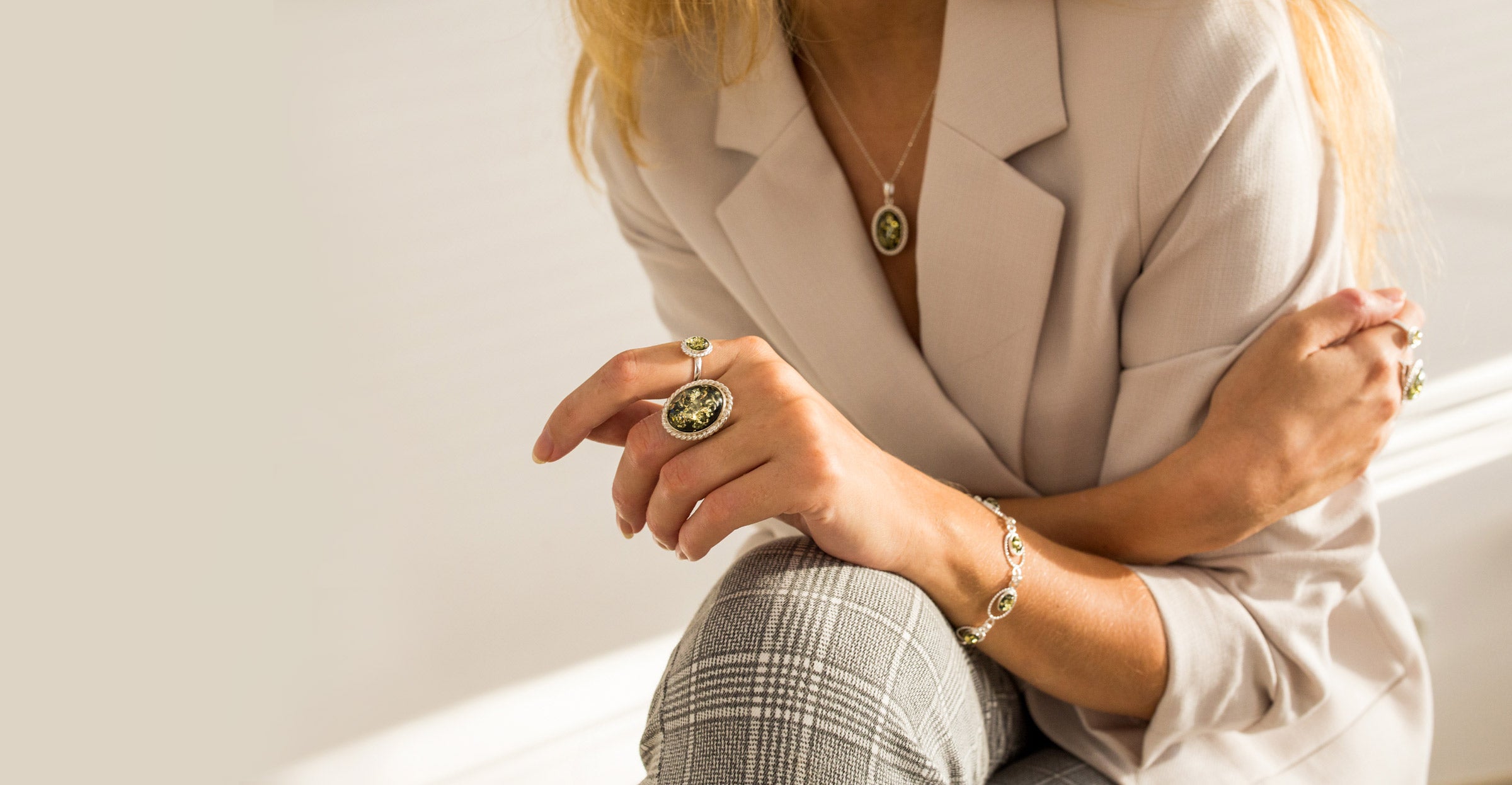
Green amber. Often slightly more porous than cognac or honey due to the natural plant matter trapped inside. Limit cleaning to once a week even with daily wear. Skip the jojoba oil polish entirely. Our about Baltic amber page covers the colour origins in more detail.
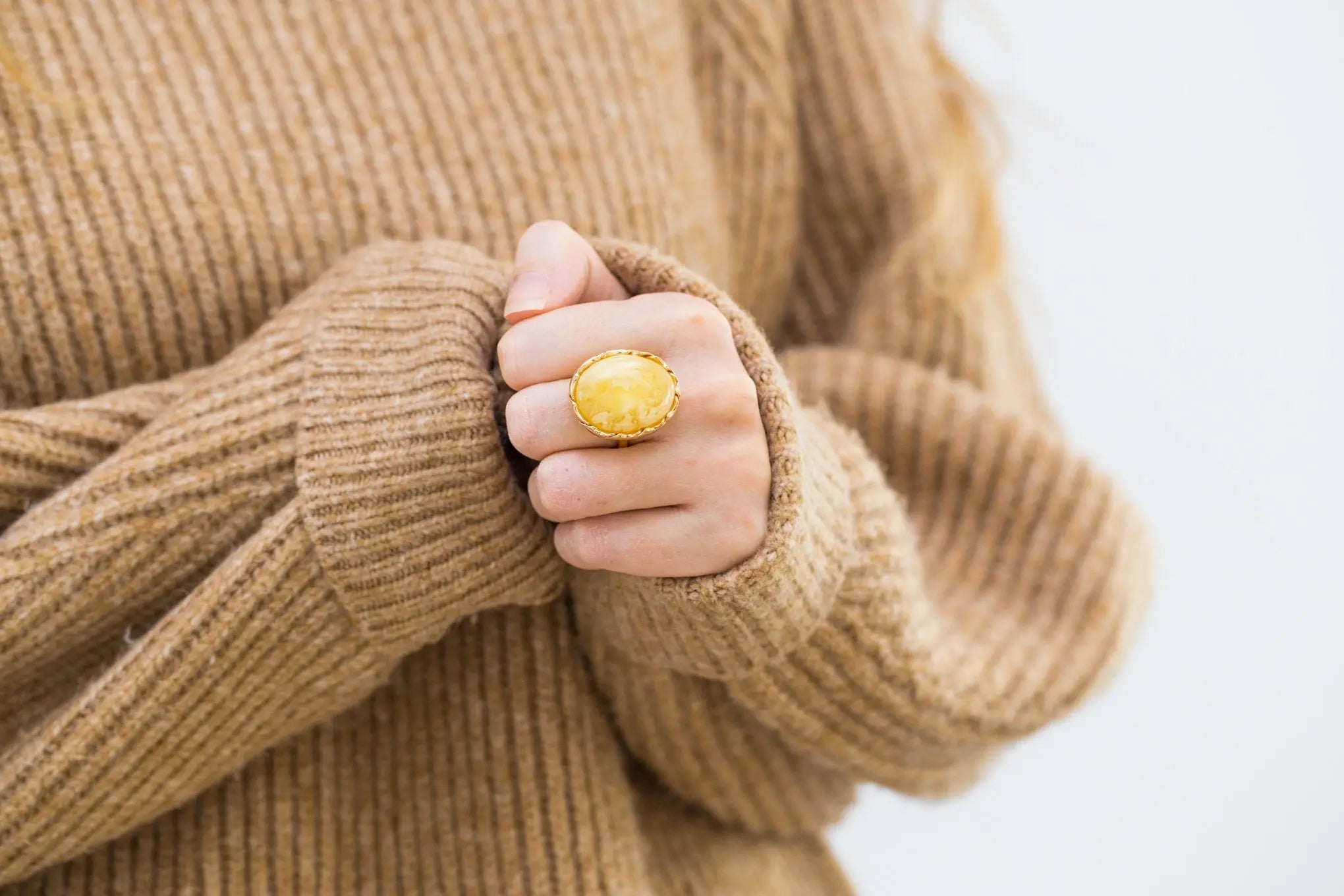
White amber. Also called royal or bone amber, this variety contains microscopic gas bubbles that create the milky appearance. Those bubbles make the surface fragile. Use only the lightest touch with a damp cloth and never any oil treatment.
Cherry amber. The deep red comes from natural oxidation over millions of years. It is sturdy to handling but more sensitive than honey amber to UV light. Indoor display is fine; outdoor wear in summer should be limited if you want to preserve the depth of colour.
Cognac and honey amber. The most common Baltic amber colours and the most forgiving. Standard routine applies.
Frequently asked questions
Can I clean Baltic amber with toothpaste? No. Toothpaste contains mild abrasives designed for enamel, which is roughly four times harder than amber. The paste will scratch the surface and leave a permanent haze.
Can I shower in Baltic amber jewellery? We recommend taking it off. Shampoo, conditioner, body wash and shower gel all contain solvents and fragrances that build up on amber.
Is it safe to clean Baltic amber with washing up liquid? A drop of plain unfragranced washing up liquid in lukewarm water is borderline acceptable for stubborn marks, but only if rinsed thoroughly.
How often should I clean my amber jewellery? Once a week for daily wear pieces. Once after each wear for occasional pieces.
Will sweat damage Baltic amber? Sweat is mildly acidic and does dull the surface over time if not wiped off after wear.
Can a jeweller fix scratches on Baltic amber? Yes for fine surface scratches. Deeper cracks or chips usually cannot be repaired.